If your shoulders drift forward by mid-afternoon, you are not imagining it. Yoga for desk workers rounded shoulders is a common search because the problem is common. Hours of typing and screen time make the chest tight, the upper back stiff and the hips short and tense. The shoulders then show the result.
This guide starts with a short posture check so you can see what is actually tight. Then it gives you four drills that use simple props. You do not need a studio, although guided online yoga classes are an option if you prefer live help. A chair, a wall, a yoga block, a strap and a rolled towel are enough.
One thing to know early. Rounded shoulders are rarely just a shoulder problem. The upper back, the chest and the hips all affect the position. That is why the drills below cover all three.
How can you tell if sitting has rounded your shoulders?
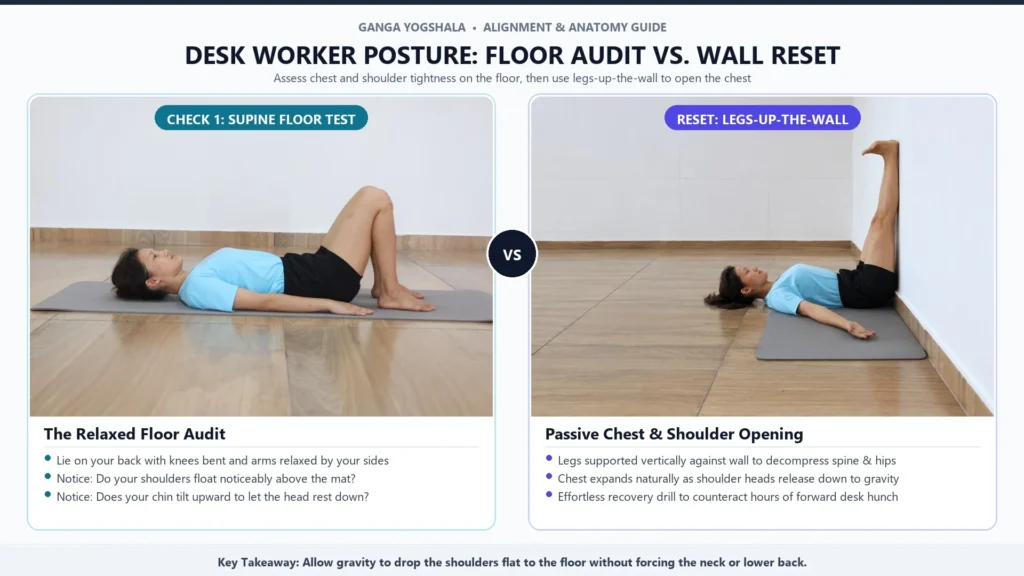
Four quick checks, about five minutes in total, will show you what is tight. They are simple self-checks, not a medical test, and a small difference between your left and right side is normal. Look for a clear pattern. It tells you which drill needs the most time.
1. The side-view check. Stand relaxed next to a mirror, or ask someone to take a photo from the side. Your ear should sit roughly above your shoulder, and your shoulder roughly above your hip. If your ear and shoulder are well in front of your hip, your chest and upper back are likely pulling you forward.
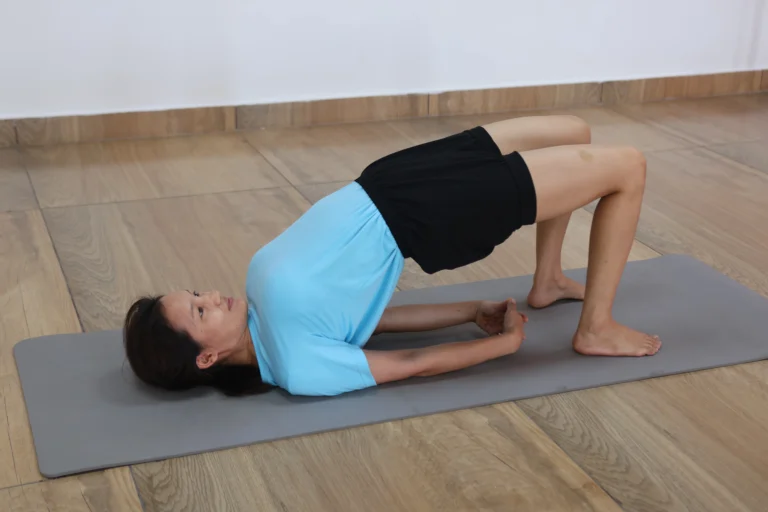
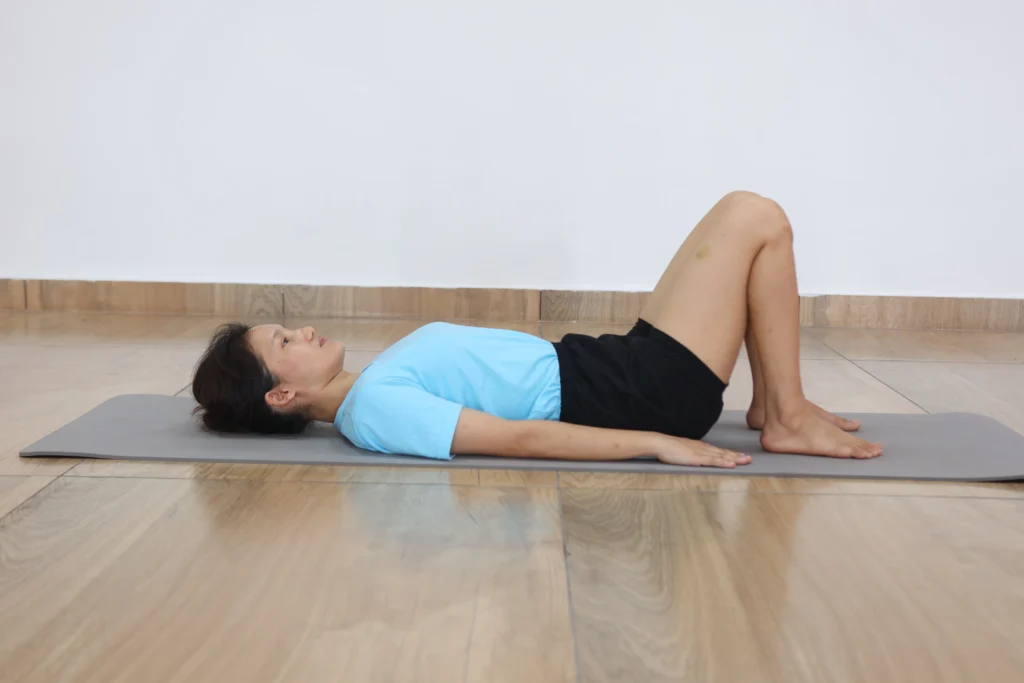
2. The floor check. Lie on your back with your knees bent and your arms by your sides. If your shoulders float above the floor, or your chin lifts so your head can rest down, your chest is probably tight and your upper back stiff.
3. The hip check. Stay on your back and hug one knee to your chest. Let the other leg rest straight. If that straight leg lifts off the floor, or the knee bends, the front of that hip is tight. Repeat on the other side.
4. The turning check. Sit tall on a chair and cross your arms over your chest. Turn as far as you can to each side without leaning. If one side turns much less, or you feel stiff between your shoulder blades, your mid-back is not moving well.
| What you notice | What it usually means | Drill to focus on |
| Shoulders float in the floor check | Tight chest, stiff upper back | Drills 1 and 2 |
| Straight leg lifts in the hip check | Tight hips | Drill 3 |
| One side turns less | Stiff mid-back | Drills 1 and 4 |
| Ear and shoulder far in front of hip | A mix of all three | The full routine |
Researchers have found that a head that sits forward, rounded shoulders and a more curved upper back often appear together. A review in the Journal of Chiropractic Medicine found that rounded shoulders were clearly linked to a more curved upper back. The authors also say it is unclear which one causes the other. So no single stretch fixes everything on its own.
Why does sitting for hours pull the shoulders forward?
When you sit, your chest and hips stay in a tight, closed position for hours. Meanwhile your upper back muscles stay stretched and tired. Your body adapts to what it does most. Over time the chest becomes tight, the mid-back gets stiff, and the shoulders rest further forward than before.
Three areas matter here, and each one matches a drill later in this guide.
The upper back. The middle part of your spine is called the thoracic spine. It is meant to turn and bend backward a little, but most desk setups keep it rounded forward all day. When it gets stiff, your shoulder blades cannot settle back, and your neck often works harder to make up for it. This is why thoracic mobility yoga is at the centre of any plan for rounded shoulders.
The chest and front of the shoulders. Your arms reach forward for the keyboard and mouse. The chest muscles get short and turn your shoulders inward. Opening the chest helps, but only if the upper back can move too. Otherwise the stretch moves to your lower back instead.
The hips. The hip flexors are the muscles at the front of your hips. They stay short when you sit. When you stand up, they can tilt your pelvis and add extra curve to your lower back, and your body may change how it stacks your ribs and shoulders to cope. That is why hip flexor stretches for sitting all day belong in a plan that is mainly about the shoulders.
Sitting is not the only cause. Phone use, a low screen, carrying a heavy bag, sleeping position and general strength all play a part. Yoga for desk workers rounded shoulders is one tool among several, not a guaranteed fix.
How do you open a stiff upper back and tight chest with props?
Start with two drills where a prop does some of the work for you: a supported backbend over a yoga block, and a shoulder opener with a strap. Together they take about six minutes. They are the core of yoga for desk workers with rounded shoulders because they work directly on the upper back and chest, and they are gentle enough to repeat daily.
Drill 1: Block-supported fish pose
Props: one yoga block, and a folded blanket or cushion for your head if needed.
This drill gently bends your upper back backward with support. That is the opposite of how it sits at your desk.
- Lie on your back with your knees bent and your feet flat on the floor.
- Lift your hips a little and slide a block under your upper back, just below the bottom tips of your shoulder blades. Use the lowest height of the block first.
- Rest your head on the floor. If your chin tips up and your neck feels squeezed, put a folded blanket under your head.
- Open your arms out to the sides with palms up, or rest them on your belly. Straighten your legs only if your lower back stays comfortable. Otherwise keep your knees bent.
- Breathe slowly into your ribs and chest for one to three minutes. Then roll to one side to come out.
What you should feel: a wide stretch across your chest and between your shoulder blades. Pinching in your lower back or numb arms means the block is in the wrong place or too high. Move it or stop.
Drill 2: Strap shoulder opener
Props: one yoga strap, or a belt or scarf.
This drill stretches your chest and the front of your shoulders. It also stops your ribs from sticking out, which is a common way people cheat in overhead stretches.
- Stand with your feet hip-width apart and hold the strap in both hands, wider than your shoulders. Start with a wide grip.
- Gently draw your lower ribs in, as if zipping up a jacket, and keep your neck long.
- Breathe in and lift the strap forward and overhead as far as you can with straight arms and no strain.
- Breathe out and move the strap down behind you only as far as your shoulders allow. If your elbows bend or your ribs push forward, hold the strap wider.
- Move slowly back and forth eight to ten times, then rest.
If your neck or shoulders feel tight: keep the strap in front of you and hold it overhead for five slow breaths. Over several weeks, you can bring your hands a little closer together.
How do you release tight hips and get your back turning again?
The next two drills focus on your hips and mid-back. A low lunge with a chair lengthens the front of your hip. A seated twist with a block helps your mid-back turn again. Both can be done in office clothes in about five minutes.
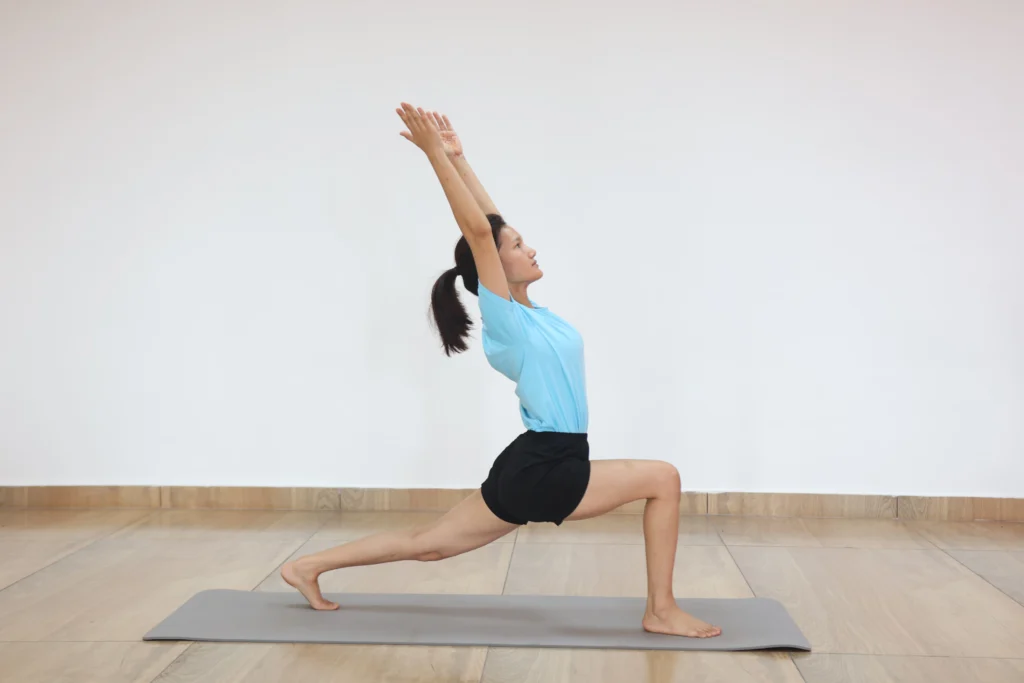
Drill 3: Chair-supported low lunge
Props: a sturdy chair or a wall, and a folded towel or mat for your back knee.
If you want hip flexor stretches for sitting all day that feel comfortable for most people, start here. The chair takes weight off your hands, so you can focus on your hips instead of your balance.
- Stand facing the seat of a steady chair, or put your hands on a wall at chest height.
- Step one foot back and lower that knee onto a folded towel. Keep your front knee right above your ankle.
- Tuck your tailbone down a little, as if flattening the arch in your lower back. This detail matters more than how far you move forward.
- Shift your weight forward a small amount until you feel a stretch at the front of your back hip.
- Stay for five to eight slow breaths, then switch sides.
Common mistake: arching your lower back to go deeper. If you feel it in your lower back instead of your hip, shorten your step and tuck your tailbone again. A small stretch done well is better than a big one done badly.
Drill 4: Chair twist with a block
Props: a chair (without arms is easiest), and one yoga block.
This is a seated move from thoracic mobility yoga. Squeezing a block between your knees keeps your hips still, so the turn comes from your mid-back and not your lower back.
- Sit tall near the front of the chair with your feet flat on the floor and a block between your thighs.
- Press your knees gently into the block and sit tall as you breathe in.
- As you breathe out, turn your chest to the right. Hold the back of the chair, or place your hands on your opposite thigh. Use your hands to guide the turn, not to force it.
- Keep your head in line with your chest and your shoulders level.
- Hold for five breaths, return to the centre as you breathe in, and repeat on the left. Do two rounds.
Check yourself: the turn should feel like it starts between your shoulder blades. If your lower back is doing the turning, bring your knees closer together and turn less.
How often should you do these drills, and what results can you expect?
All four drills take about 15 minutes. Doing them four to five times a week is a good starting point. Yoga for desk workers rounded shoulders works best as short, regular practice, not one long weekend session. Posture changes slowly, so judge progress over weeks, not days, and by how your body feels more than how a photo looks.
| Order | Drill | Props | Time |
| 1 | Block-supported fish pose | Block, optional blanket | 1 to 3 minutes |
| 2 | Strap shoulder opener | Strap or belt | 8 to 10 slow passes |
| 3 | Chair-supported low lunge | Chair or wall, towel | 5 to 8 breaths per side |
| 4 | Chair twist with a block | Chair, block | 5 breaths per side, 2 rounds |
The order is on purpose. The supported backbend comes first so your upper back can soften. The strap drill then uses that extra room. The hips and twist finish while your body is warm.
What to expect. Many people feel less tight in the chest and upper back within the first week or two. Changes in how you stand and sit take longer. They depend on how many hours you sit, how your desk is set up, and whether you also build strength in your upper back. Stretching alone rarely lasts. A few rows with a resistance band or light weights, and standing up every 30 to 60 minutes, help the drills work.
Fitting it into your day. The block and strap drills suit the end of the day, when you are done with the screen. The chair lunge and chair twist can be done between meetings. If you prefer to be guided through a similar routine, a live session gives you tips on form that written steps cannot. Either way, the goal is the same: regular movement for the parts of your body that stay still at a desk. That is the idea behind most office posture yoga.
When should you stop and see a professional instead?
Stop and get checked if you have sharp pain, pain that does not go away or keeps getting worse, numbness or tingling in your arms or hands, or a curve in your spine that has changed recently. Gentle stretching is fine for the normal stiffness that comes from sitting. It is not the right choice for signs of a nerve or bone problem.
Take extra care before trying yoga for desk workers with rounded shoulders in these situations:
- Osteoporosis or past spine fractures. Backbends and twists need personal guidance. Ask a doctor or physiotherapist which positions are safe for you.
- Neck, shoulder or back disc problems. Skip the overhead strap range and keep your head supported in Drill 1.
- Pregnancy. Lying flat on your back may not be comfortable or advised later in pregnancy. Ask your doctor or midwife first.
- Knee problems. Pad the knee well in Drill 3, or do a standing version with your back foot raised on a low step.
- Sudden changes. New rounding, loss of height, or back pain that wakes you at night should be checked by a doctor.
Pain during a drill is a sign to ease off. A mild stretch is normal. Sharp, pinching or electric feelings are not. It is always fine to come out early. A smaller version done well is more useful than a bigger one done with tension.
Stuck at a desk all day? Join our 45-minute evening live online mobility batch designed for remote working professionals. Book an online class trial