Have you ever come out of camel pose (Ustrasana) with a sharp, pinching feeling in your lower back? You are not alone. Many people ask why does lower back hurt in camel pose, because the pose looks like it should only open the chest. Most of the time, the backbend is happening in the wrong place. This guide shows where the pain comes from, how to tell what is going wrong, and how to do camel pose with blocks so the bend moves up into your upper back. It is written for people who practice at home or in online yoga classes, where it can be hard to get your form checked in the moment.
What Actually Causes Lower Back Pain in Camel Pose?
Lower back pain in camel pose usually happens because your lower back bends too much. Your lower back and neck bend more easily than your upper back. So your body takes the easy path and folds into the lower back. This squeezes the base of your spine while the upper back stays stiff.
Experienced yoga teachers see this pattern often. Many people move easily in the neck and lower back, so they bend there every time. Meanwhile, the upper back gets stiffer. Camel pose can fix this, but for many people it makes the habit stronger. This is the root of the “why does lower back hurt in camel pose” question. A few things feed into it.
A stiff upper back. If your upper back does not bend much, your lower back bends more to make up for it. The pose looks like a backbend, but your lower back is doing most of the work.
Tight hips. The muscles at the front of your hips are called hip flexors. When they are tight and you keep your hips right above your knees, your lower back bends too far to make up for it. This squeezes the lower back and can pull your neck out of line too.
Hips pushed forward. Pushing your hips far ahead of your knees to go deeper is another way the lower back takes over. Teachers often say this is the body’s way of avoiding a bend in the upper back.
Sleepy glutes and lower belly muscles. Many teachers say the bend should come from the middle and upper back. Your glutes (buttock muscles) and lower belly muscles keep the lower back steady. If they switch off, nothing holds your lower back in place.
Reaching for the heels too soon. Many pose guides say beginners can keep their hands on their lower back or use blocks until they can hold a clean line. If you reach for your heels before your spine is ready, you turn camel pose into a lower back bend.
How Can You Tell Which Cause Is Behind Your Pain?
Where and when it hurts gives you clues. The table below is a simple self-check to help you pick what to try first. It is not a medical diagnosis.
| What you feel | What may be going on | What to try first |
| Pinching at the bottom of your spine as you lean back | Your lower back is doing most of the bend | Lean back more slowly, squeeze your glutes and lower belly lightly, keep your hands on blocks |
| Pain grows as your hands reach for your heels | You are going deeper than your body is ready for | Use taller blocks or keep your hands on your hips |
| Tight hips at the front plus lower back strain | Tight hip flexors | Let your hips move a little back toward your heels and hold for a shorter time |
| Neck strain or feeling light-headed | Your head dropped back before your chest lifted | Keep your head still or your chin slightly tucked |
| Sharp, shooting pain or numbness | A possible nerve or disc problem | Come out of the pose and ask a health professional |
A mild stretch across the front of your thighs, belly, and chest is normal in a backbend. Pinching or sharp pain in the lower back is different. It means you should ease off. A common teaching rule is to go back to an easier version at the first sign of lower back pain. It is a good rule to follow.
Should the Hips Stay Over the Knees in Camel Pose?
It depends on how flexible your hip flexors are. Many people are told to keep their hips right above their knees, and it works well for some. For others, it squeezes the lower back more, and moving the hips a little back toward the heels can help.
One common view is that many people can keep their hips right above their knees with no trouble. This is more likely if the hip flexors are flexible. If your hips are tighter, a common tip is to let your hips move a little toward your heels. This takes pressure off the hip flexors and off your lower back. You only need to change your position if it helps you feel better and keep a neutral, steady spine.
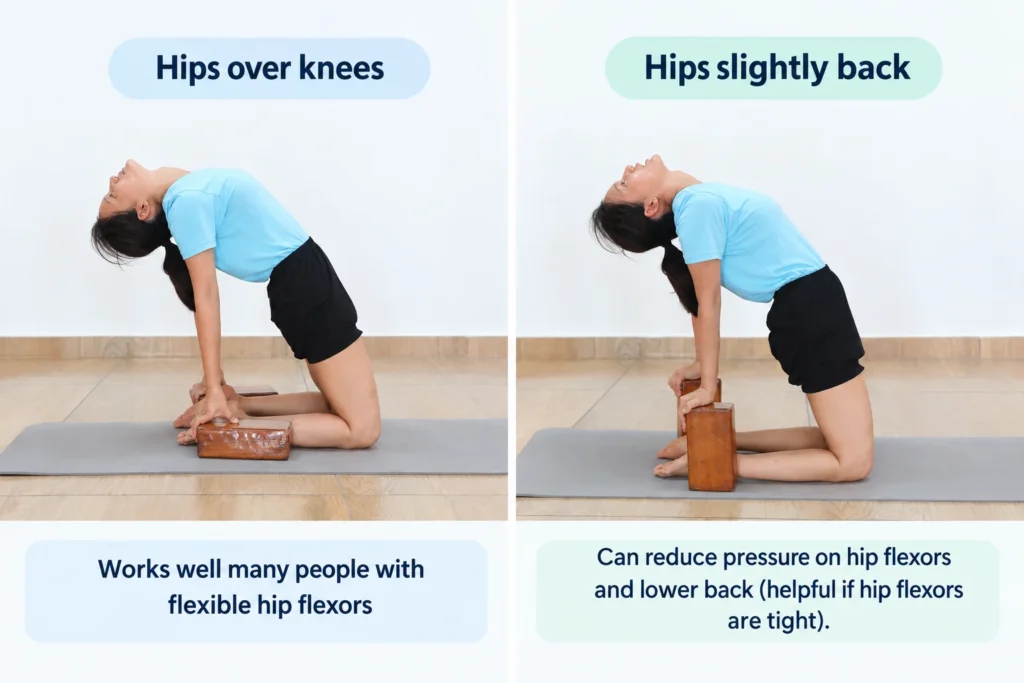
Another popular cue sounds like the opposite. It says to keep your hips above your knees and not let them drift forward, because drifting forward is a way to avoid bending the upper back.
Here is one way to see it. The two cues guard against different problems. The stacked-hips cue stops your hips from shooting forward to chase depth. The move-back tip takes pressure off tight hip flexors. A simple way to practice is to start with your hips over your knees. If your lower back pinches, move your hips back a small amount and see if the pinch fades. Your own body is the guide, not one fixed rule.
How Does Using Blocks Change Camel Pose?
Blocks bring the floor closer to your hands, so you do not need to bend back as far. This lets you focus on lifting your chest and pulling your shoulder blades together instead of reaching for your heels. Camel pose with blocks is a common way to make the pose easier for this reason.
A common tip is to set the blocks to their tallest height and place them just outside each ankle. You will not go back as far with blocks as you would when holding your heels. That helps you control the bend and place it more exactly. Many teaching guides give the same tip.
Blocks do not fix poor form by themselves. They give your hands a steady place to rest so you can notice where the bend is happening. If your lower back still pinches with your hands on tall blocks, the cause is more likely your hips, your glutes, or how fast you lean back, not how far you reach.
Some teachers also suggest holding a block between your thighs and squeezing it gently. This keeps your inner thighs active and your knees from drifting apart. It is optional, and it works best once the basic shape feels steady.
How Do You Do Camel Pose with Blocks, Step by Step?
Place two blocks at their tallest height next to your ankles, kneel up straight, hold your hips with your hands, and lean back only as far as your chest can keep lifting. Each step below helps keep the bend out of your lower back. These steps follow common ustrasana alignment for beginners from teaching advice.
- Set up the blocks. Put a block just outside each ankle at its tallest setting. Kneel with your knees about hip-width apart and your thighs straight up and down. If your knees hurt, fold a blanket under them. You can tuck your toes if that makes reaching easier.
- Start with your hands on your hips. Put your hands, or loose fists, on the back of your pelvis. Some teachers say your fists should rest on the pelvis bones and not on the soft muscles of the lower back.
- Wake up your support muscles. Gently pull your lower belly in and up. Squeeze your glutes lightly, but do not clench hard. This gives your lower back support before you move.
- Lift your chest first. Raise your breastbone and pull your shoulder blades toward your spine. Teachers stress lifting and opening the chest before you lean back at all.
- Lean back slowly. At the start, keep your hips about above your knees. If your lower back pinches, move your hips back a little toward your heels and check again.
- Reach for one block, then the other. Keep lifting your chest as your hands arrive. Let your shoulder blades help create the bend in your upper back.
- Decide what to do with your head. Keep your neck still. Teachers often say to drop your head back only when your chest is lifting strongly. A slightly tucked chin can help if your neck still feels sore once your lower back feels fine.
- Stay for a few breaths. Keep breathing. A short hold with good form is more useful than a long hold that strains your lower back.
- Come out chest first. Press your hands into the blocks, lift your chest, and come back up to kneeling. Sit back on your heels to rest. Some teachers recommend waiting until you have finished all your camel pose tries before resting in Child’s Pose, and several guides list Child’s Pose as a common pose to do afterward.
If you still feel strain in your lower back at the end, go back one step and stay there longer. Keeping your hands on your hips is a full version of the pose, not a lesser one.
How Should You Warm Up Before Camel Pose?
Warm up by moving your whole spine and opening the front of your hips and chest before you lean back. Camel pose is usually done late in a class, after the body is ready. A cold spine tends to bend in the easiest place, which is the lower back.
Moving between Cat and Cow is a commonly recommended way to warm up the spine. Gentle movement through your whole back helps your upper back join in.
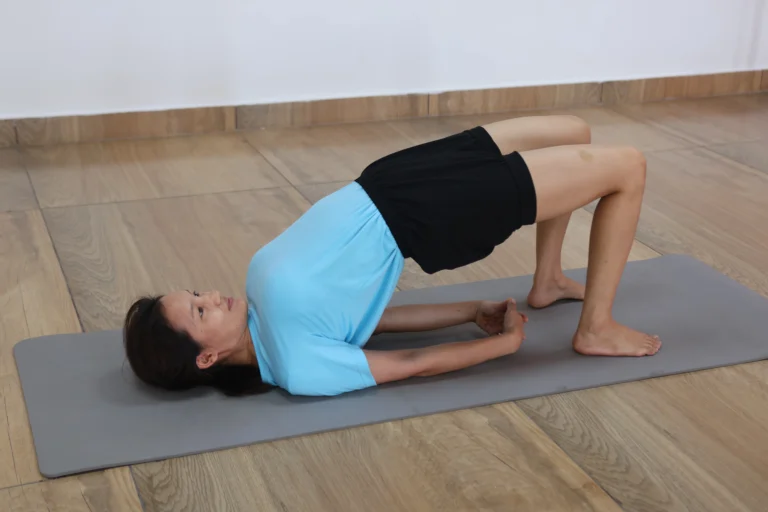
Bridge pose is also a good practice step. Teachers often point out that bridge is basically camel pose with the floor in a different place. Lying on your back lets you feel how your hips, glutes, and chest share the work without having to balance on your knees.
Sphinx pose is a gentler backbend with your forearms supporting you. A low lunge is a common way to open the hip flexors, which connects to the tight hips point above. You do not have to do them, but each one helps you practice bending back without relying on your lower back.
What Should You Do If the Pain Does Not Go Away?
Go less deep, switch to an easier version, and see a health professional if the pain lasts or spreads. A little stiffness after a hard session is normal. Pain that stays, comes back every time, or travels down your legs is different. If the “why does lower back hurt in camel pose” question is still not answered after you fix your form, the cause may not be your technique.
Take extra care if you already have back problems. Camel pose puts a lot of pressure on the lower back. It can be a problem for people with lower back or disc issues. Keeping your hands on your lower back for support is one way to ease in. Some pose guides list a slipped disc as a reason to avoid the pose. A doctor or physiotherapist can tell you whether camel pose is right for your back.
It also helps to look at the wider research. A Cochrane review of yoga for long-lasting lower back pain with no clear cause was published in the Cochrane Database of Systematic Reviews. It found weak evidence, which the authors call low certainty, that yoga raised the risk of side effects, mostly more back pain, in some people. The classes in the review were made for people with lower back pain and led by experienced teachers. The review did not study camel pose. So it makes only a small point here: yoga can make the back worse for some people. That is one more reason to move slowly and stop when you feel sharp pain.
How Can You Keep Backbends Safe Over Time?
Safe yoga backbends spread the bend across your whole spine, go deeper slowly, and use easier shapes when your body is not ready. Camel pose does not have to be your goal. It can be one step on a longer path.
A simple path looks like this:
- Start with gentle backbends such as Sphinx pose and Bridge pose to build strength and comfort.
- Try Half Camel, or camel with your hands on your hips, once those feel fine.
- Move to camel pose with blocks at their tallest height.
- Lower the blocks, or reach for your heels, only if your lower back stays quiet and your chest keeps lifting.
If you cannot find a comfortable version of camel pose, Bridge pose is a good swap. Choosing it is smart, not a failure.
Feedback helps because the cues in camel pose are small, as the two hip cues show. Tiny changes in your hips, ribs, and shoulder blades are hard to see from inside the pose. A teacher who can watch your form, in a studio or online, can point out a pinch before it becomes a habit.
How often you practice matters too. A few well-aligned tries at the end of a warm practice are usually more useful than many rushed ones. Rest between tries, and keep your lower back quiet each time.
What Should You Remember Before Your Next Camel Pose?
Lower back pain in camel pose is usually a sign that the bend has moved into the lower back. You can often fix it by changing where the bend happens. Warm up your upper back, switch on your glutes and lower belly muscles, lift your chest before you lean, and rest your hands on tall blocks instead of reaching for your heels.
So if you are still wondering why does lower back hurt in camel pose, start with three simple checks: how fast you lean, where your hips are, and how high your hands are. Change one thing at a time and see what happens. Stop if the pain is sharp or travels, and talk to a health professional if it does not go away.
Never practice deep backbends blindly from YouTube. Experience live two-way adjustments in our morning online batches.