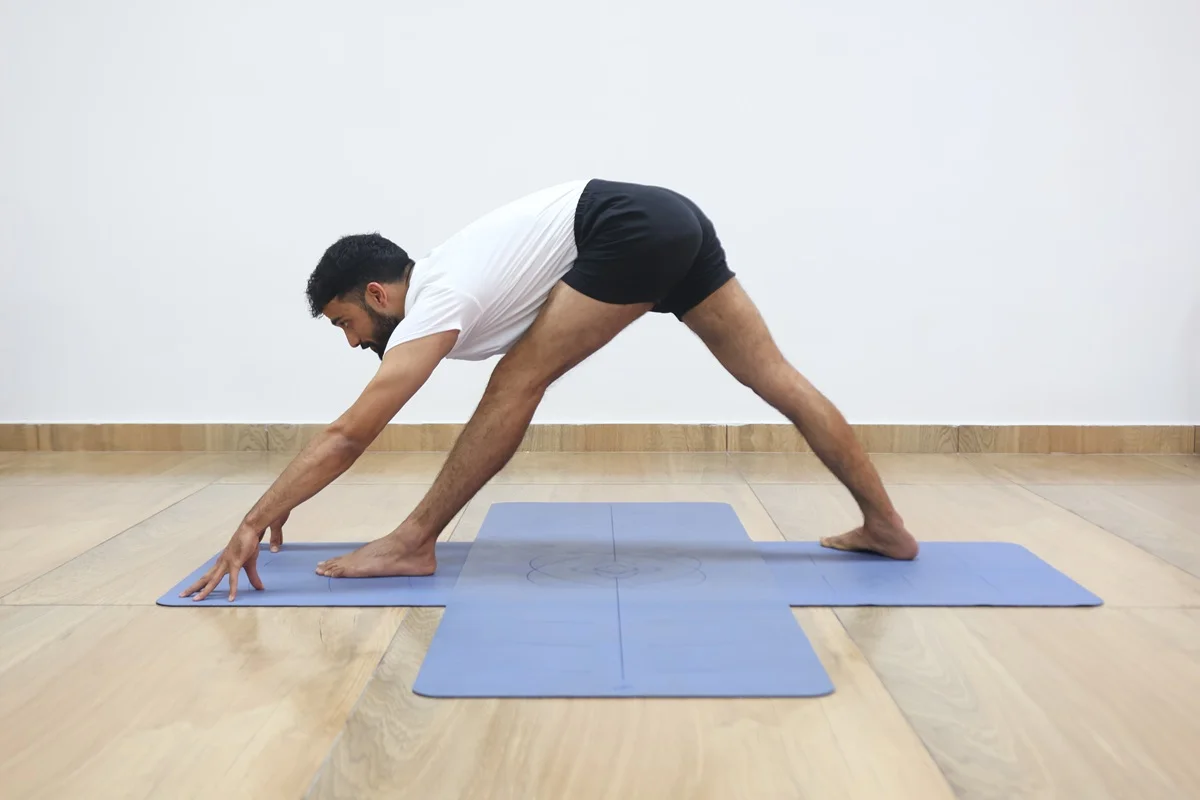
Pyramid Pose looks simple from the outside: one leg forward, one leg back, and a fold over the front leg. In practice it often turns into a negotiation. The hips swing out, the front knee snaps backward, and the upper back rounds in an effort to reach the shin. These three habits share one cause, which is trying to fold deeper than the hips and hamstrings are ready to allow. This guide collects practical Parsvottanasana alignment tips for each habit, using two blocks, a wall, and one simple hand cue, so that the fold comes from the hip joint instead of the knee and the spine.
What is Parsvottanasana actually asking your body to do?
Parsvottanasana asks you to fold forward from the hip joints over the front leg while keeping the spine long. The pelvis may face generally toward the front, but it does not need to be forced square. The stretch may be felt along the back of the front leg. Use a comfortable knee position and adjust the stance or props to suit your body.
The hamstrings attach near the sitting bones and cross the back of the knee. As you hinge forward at the hips, the muscles along the back of the thigh lengthen. The amount of stretch depends on your anatomy, knee position, and how far you fold.
If the back of the front leg feels tight before your hands reach the floor, avoid forcing a deeper fold. You may bend the front knee slightly, adjust the stance, or use blocks. Do not push the knee backward, twist the pelvis, or round the spine simply to reach lower.
How should you set your feet so the pelvis can face forward?
Step the back foot behind the front foot and turn it out to a comfortable angle; roughly 30 to 45 degrees can be a starting point, not a fixed rule. Keep some width between the feet, like railway tracks rather than a tightrope. Adjust the distance and angle so the pelvis can turn comfortably without twisting the knees or lower back.
Think of the feet as railway tracks rather than a tightrope. When the heels sit on a single line, the pelvis has to rotate more to face forward, and many people simply cannot get there. A little width between the feet gives the hips room to square without twisting the knee or the lower back.
Here is a setup that builds the pose in a stable order:
- Stand with your back a few feet from a wall and your hands on your hips.
- Step the left foot back until the left heel can rest against the base of the wall, then turn that foot out about 45 degrees.
- Press the back heel into the floor and into the wall. This anchors the back leg and keeps the foot from sliding.
- Turn your hip bones generally toward the front of the mat, only as far as feels comfortable. If the pelvis will not face fully forward, widen or shorten the stance rather than forcing it.
- Keep the front knee active and avoid pushing it backward. A small bend is fine if it helps you maintain a long spine without discomfort.
- Inhale and lengthen the spine upward before you fold.
The wall behind the heel is a simple anchor, and it removes one variable. When the back foot cannot move, the pelvis has a fixed reference to square against.
Why does the pelvis swing out in Pyramid Pose, and how do you level it?
The back-leg-side hip may remain slightly behind the front hip, so the pelvis is not perfectly square. Rather than forcing it level, adjust your stance and allow the pelvis to face forward only as far as your hips comfortably permit.
The pelvis may rotate as you turn the back foot out. Trying to force both hip bones to face directly forward can create unnecessary tension. Use a stance width and foot angle that allow you to fold without twisting or discomfort.
You can use your hands to notice the direction of your hip bones, but do not force them into a straight line. Lengthen the spine on an inhale and hinge forward only as far as you can keep the movement comfortable. A teacher can help you find a suitable range for your body.
Stop at the point where you can maintain a comfortable stance and a long spine, even if that is only a shallow fold. A smaller range is a valid version of the pose.
Why does the front knee lock backward, and how do you protect it?
The front knee may move toward hyperextension if you push it backward, particularly when the hamstrings feel tight. Keep the leg active without forcing it straight, and use blocks to reduce the need to reach toward the floor.
Hyperextension means the knee moves beyond its usual straight position. Some people naturally have knees that extend beyond straight, and a small amount of hyperextension is not automatically an injury. Avoid hanging into the back of the joint or forcing the knee farther backward.
To practise comfortably in Pyramid Pose, keep an even, stable contact through the front foot. Engage the front thigh gently without pushing the knee backward. Hinge from the hip while keeping the spine long, and use blocks if your hands do not reach the floor.
If the hamstring pulls so strongly that the knee wants to bend, let it bend a little. A slightly softened knee with a long spine is a better pose than a straight leg with a collapsed back.
How do blocks help you reach the floor without rounding your spine?
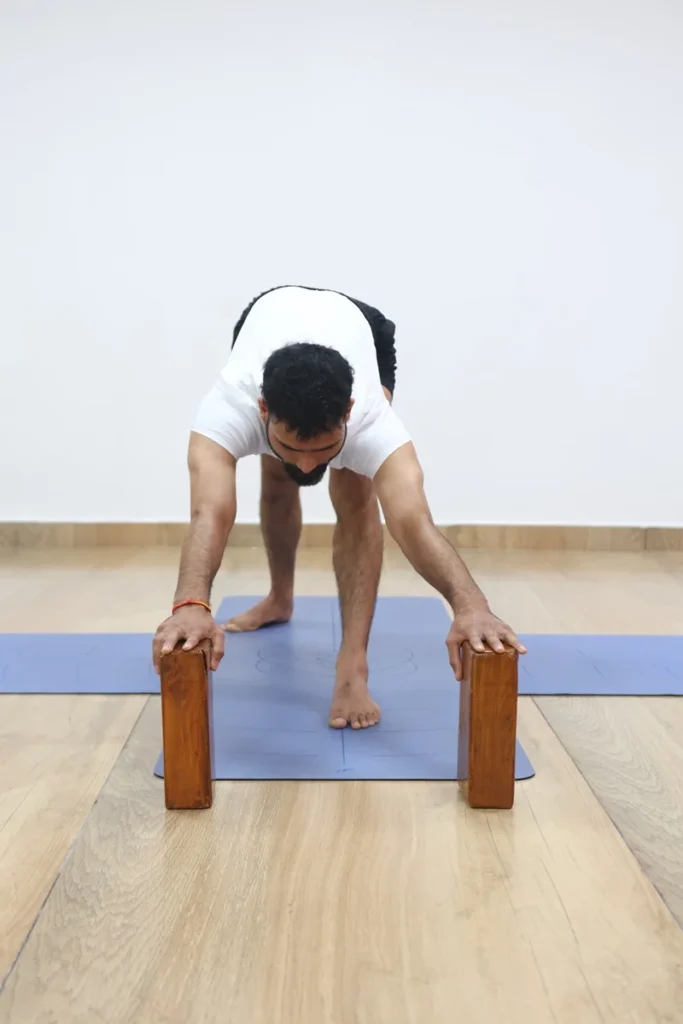
Two blocks on their tallest setting, placed on either side of the front foot, bring the floor closer so your hands can rest while the spine stays long. The hands support the fold. They are not the reason for it, and they should not pull you down.
Some practitioners round the upper back when trying to reach the shin or floor. If the hamstrings or hips limit the fold, use blocks or bend the front knee slightly rather than pulling yourself lower. Aim to hinge from the hips while keeping the spine comfortable; a deeper fold is not necessarily a better one.
Set the blocks and use this order:
- Place a block on each side of the front foot, under the shoulders, with the blocks on their tallest setting.
- Rest your fingertips on the blocks and lift the chest forward, as though the breastbone is reaching for the front of the mat.
- Lengthen the spine until the back feels flat from the tailbone to the neck.
- Keep the thumb in the front hip crease and hinge only as far as the spine stays long.
- Stay for a few breaths, then lift the torso on an inhale, keeping the spine long all the way up.
If the blocks feel high, that may be the right setup for your current range. You can lower them gradually only if you can maintain a comfortable position and a long spine. Reaching the floor is not the goal.
How do you fold deeper without forcing the hamstrings?
Depth comes from regular, gentle exposure to the stretch, not from pulling harder in a single session. Stay in a mild to moderate stretch, breathe slowly, and let the hamstring settle before you ask for more.
It helps to know what a stretch is probably doing. A review in Physical Therapy examined why people become more flexible after stretching. The authors noted that muscle length does increase during a stretch because of the viscoelastic properties of muscle, but the effect is transient, and they discussed a sensory explanation in which improved extensibility reflects a change in how the stretch is felt. Research in this area is still developing. A practical reading is that forcing a position is unlikely to speed things up, and that patient, repeated practice at a tolerable intensity is a reasonable approach.
In Pyramid Pose, stop before the stretch becomes sharp or the pelvis twists. Stay for a few comfortable breaths, come up, and repeat only if the position still feels good. The second round may feel different, but it is not guaranteed to feel easier.
Which props help in Pyramid Pose, and when should you use each?
Blocks, a wall, and a chair each solve a different problem. Blocks raise the floor, a wall helps you feel a flat back and a level pelvis, and a chair gives the hands a higher, steadier surface. Choose the prop that matches the habit you are working on.
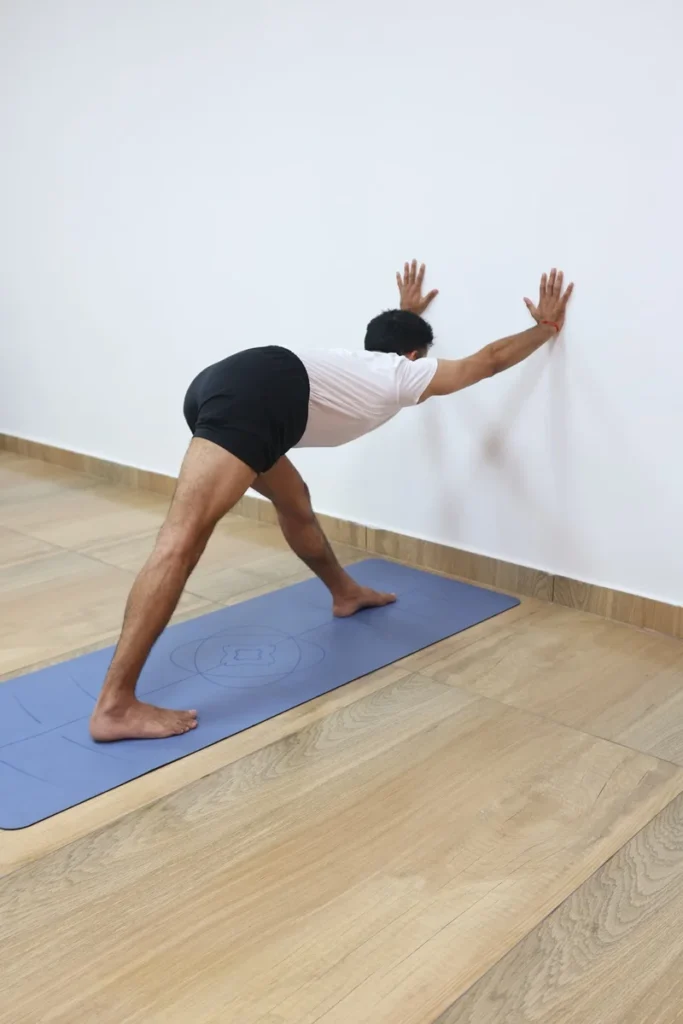
Wall hinge. Stand facing a wall with your hands on it around hip height. Walk your feet back until your arms are straight and your torso feels long. Step one foot back into a comfortable staggered stance. Let the pelvis turn only as far as it comfortably allows. The wall supports your hands and gives you feedback without requiring a deep fold.
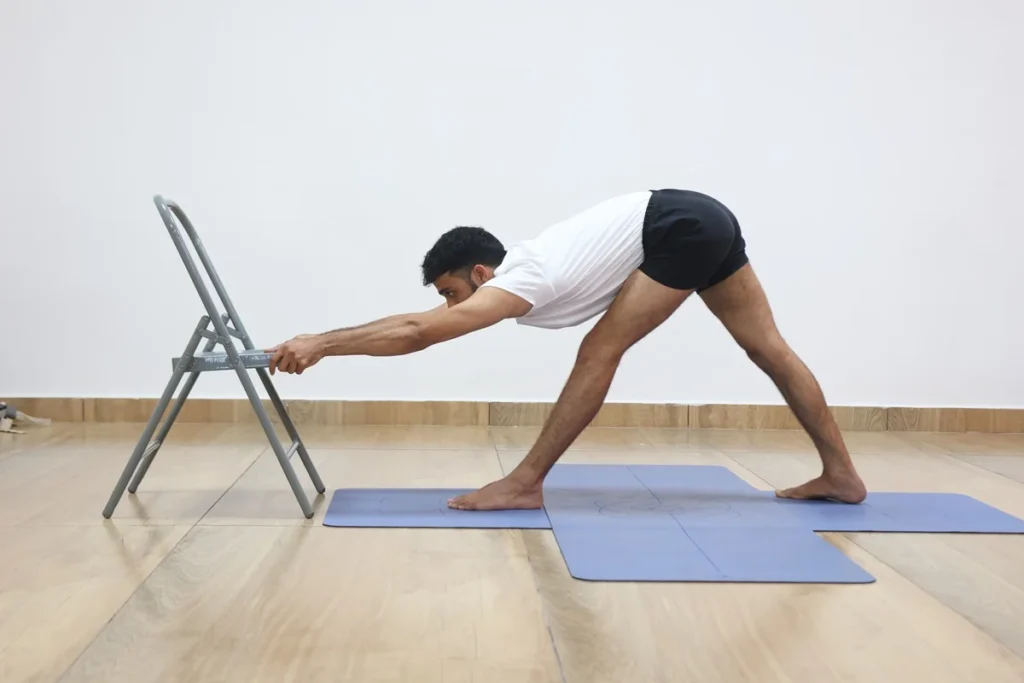
Chair seat. Set a chair at the front of the mat and rest the hands on the seat while the front foot sits near the chair legs. The higher surface lets the spine stay long and keeps the head from dropping too low.
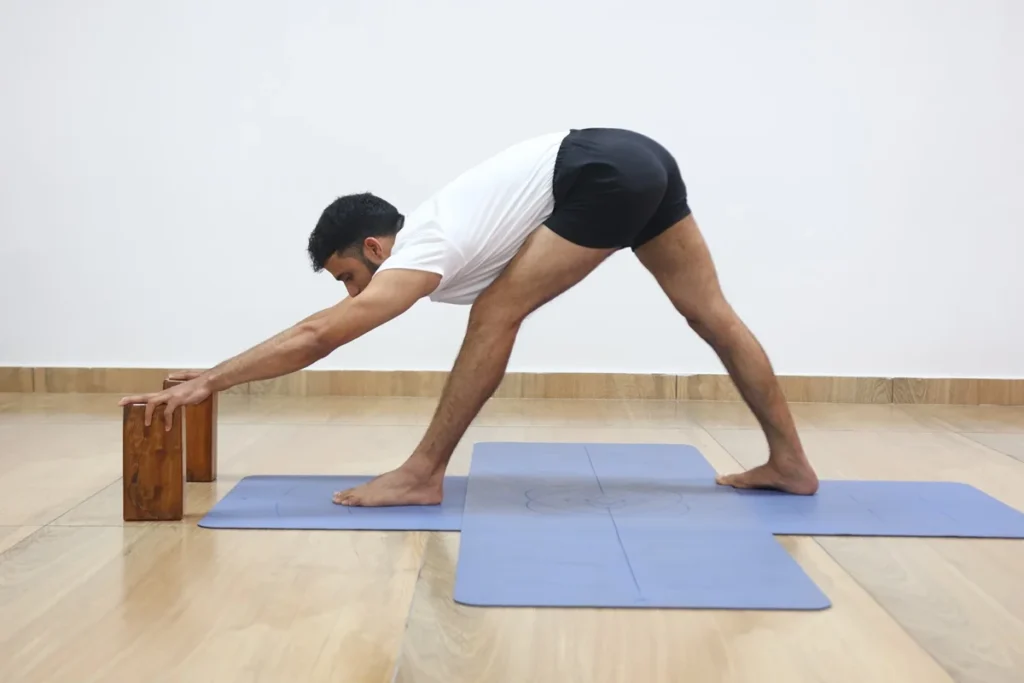
Two tall blocks. Use these once the wall and chair feel steady, or if you want the pose closer to its final form. Lower them gradually as the hamstring allows.
If you practise the classical hand position, with the palms together behind the back, treat it as optional. When reverse prayer pulls the shoulders forward or rounds the upper back, hold opposite elbows, use a strap behind the back, or rest the hands on blocks. Choose the arm position that allows you to keep the spine comfortable.
How can you check these Parsvottanasana alignment tips on your own mat?
A comfortable Pyramid Pose has a stable stance, a long spine, a front knee that is not forced backward, and a steady breath. Check the following points on each side, because the two sides may feel different.
- Hips: Let the pelvis face generally toward the front only as far as your range allows; do not force the hips square.
- Front knee: Keep the thigh active without pushing the knee backward. A slight bend is acceptable.
- Spine: long from tailbone to neck, with the chest forward and not curled toward the shin.
- Back leg: Turn the back foot to a comfortable angle, using roughly 30 to 45 degrees only as a possible starting point. Keep the foot grounded without forcing the heel down.
- Breath: smooth and even. If you hold your breath, come up a few inches or raise the blocks.
If one point fails, correct that point before you try to fold further.
Who should modify Pyramid Pose or take extra care?
If you have a recent hamstring injury, persistent back or pelvic pain, dizziness when lowering your head, or a condition for which a clinician has advised against forward folds, ask a healthcare professional how to modify the pose. Use a chair or blocks for support if appropriate.
During pregnancy, balance and comfort can change. Use a wider stance and support from a chair or blocks, and follow guidance from a prenatal-qualified teacher or healthcare professional. Stop if you feel sharp, pinching, electric, or worsening sensations.
Why is it hard to see these errors yourself, and what can you do about it?
A rotated pelvis, a knee pushed backward, or a rounded upper back can be difficult to assess from inside the pose. A phone video may help you observe your position, while a teacher watching live may offer cues. Neither replaces an assessment by a healthcare professional when pain or injury is involved.
Try a short check. Place your phone around hip height to the side of the mat and record a few seconds of the fold. Notice whether your spine stays comfortable and whether you are pushing the front knee backward. A video is only a rough visual aid; it cannot determine whether a position is safe for you.
You can book online yoga classes with Ganga Yogshala and receive live guidance on your Pyramid Pose setup.